- An observation depends on wavelength as well as resolution.
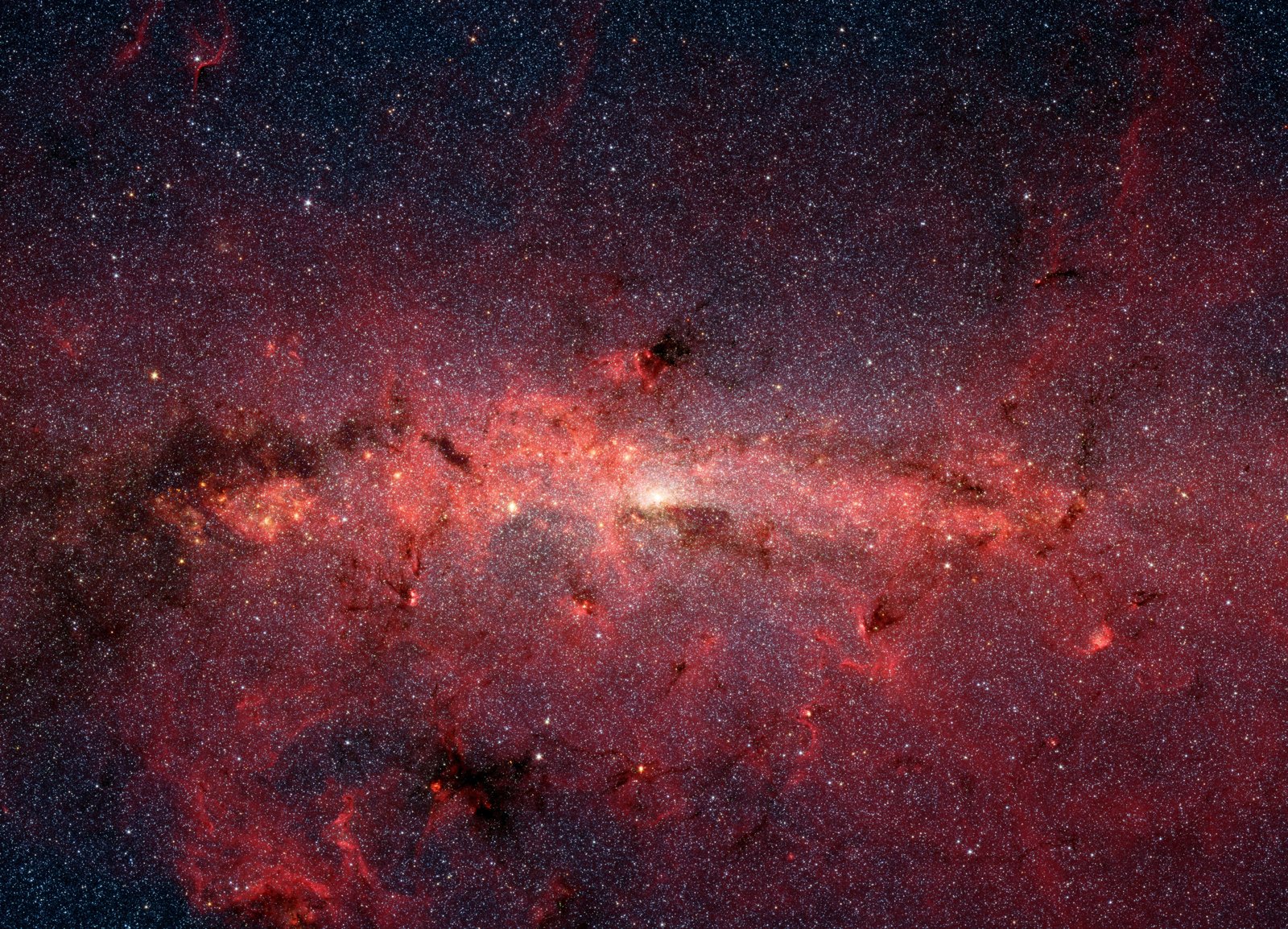
- Assigned image colors can represent invisible infrared measurements.
- An image and an interpretation are different layers of evidence.
Choose the light, change the question
Webb’s science program addresses early galaxies, star formation and other worlds through infrared observations. These are measurements designed around questions: when stars formed, how galaxies evolved, and what distant atmospheres contain. A more detailed image is useful because it can separate objects or structures that were previously difficult to distinguish.
Webb science overview ↗A palette carries information
The Spitzer mosaic of the Milky Way’s center combines infrared bands in assigned colors. The resulting view translates measurements into something we can inspect. It should not be read as a scene that a human eye would see from a spacecraft. Ask which wavelengths were recorded, how they were mapped to color and whether a caption identifies the instrument and processing.
Spitzer image reference ↗Read beyond the headline
Our editorial approach is to separate the recorded light from the model used to explain it. A telescope can provide new constraints without settling every question. When reading an astronomical announcement, look for the observation date, instrument, target, analysis and uncertainties. These details make an image more scientifically useful than a dramatic headline alone.
Science themes ↗This is an AI-assisted NRKZ Signal explainer, based on the primary references linked above. It is not original field reporting, and is not written or endorsed by those institutions. General reading frameworks are our editorial interpretation.