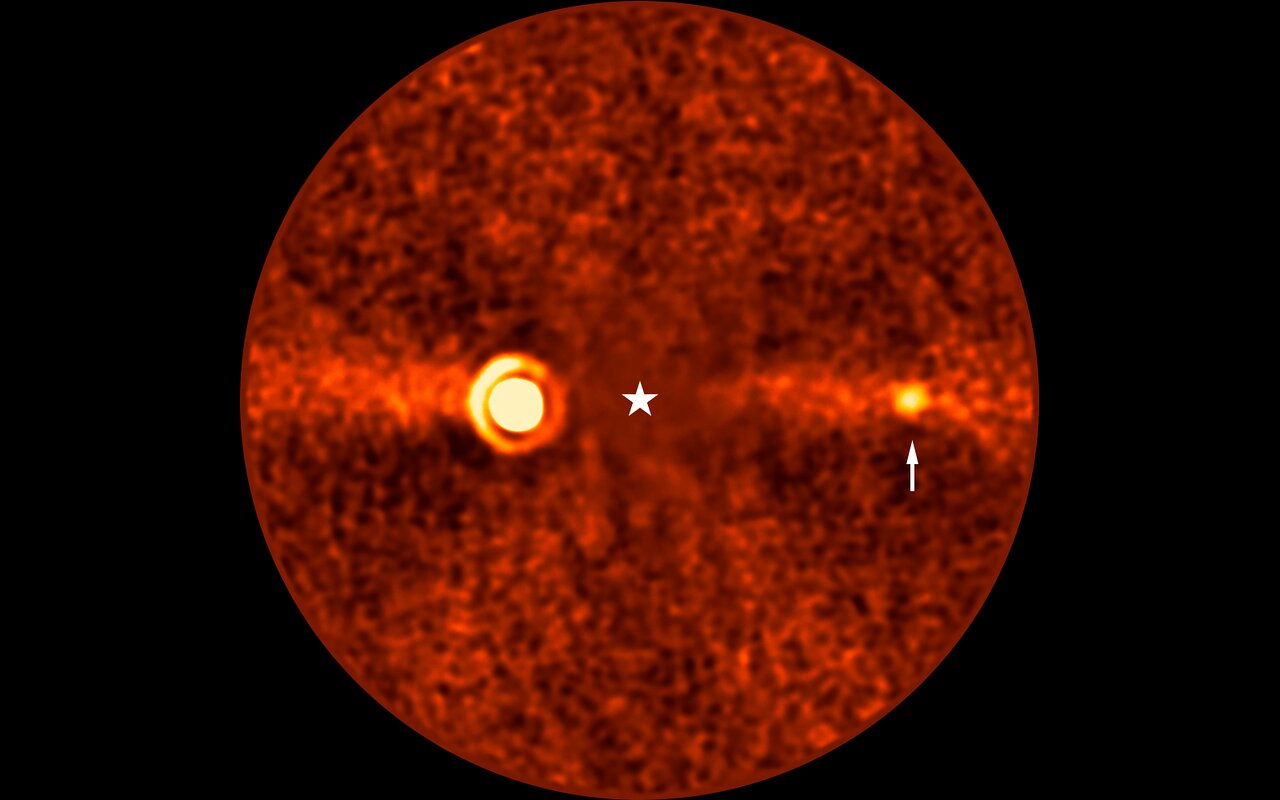
Observations made with the European Southern Observatory’s Very Large Telescope (ESO’s VLT) have revealed evidence for a moon-like object in the CD-35 2722 system.
Diffusion models, powerful generative tools, exhibit creativity by learning to interpolate between training data points, driven by neural networks' smooth score function. While impressive, this raises questions about the source of creativity. Research shows that this capability is not random but a natural consequence of neural network training smoothing the transformation from noise to data.
A team of astronomers has discovered a third planet orbiting the star Beta Pictoris, making it the faintest planet ever imaged from Earth. The new planet, Beta Pictoris d, is 100 times fainter than Beta Pictoris b and is among the lightest exoplanets ever imaged from the ground. The discovery was made after more than a decade of searching through archive observations.
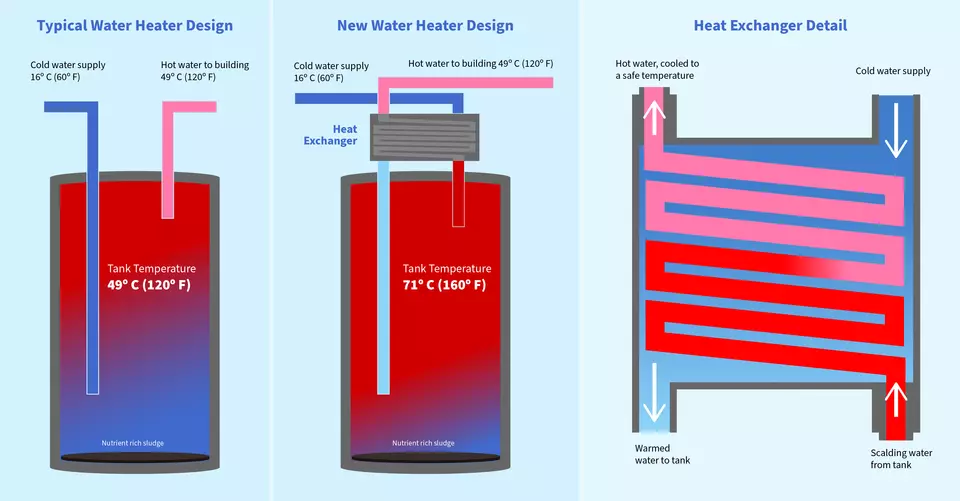
NIST has been granted a patent for a water heater system that kills harmful bacteria, reducing the risk of Legionnaires' disease and other infections while also preventing scalding. The new system uses a heat exchanger to safely heat water to a higher temperature, killing bacteria like Legionella pneumophila. This innovation addresses the growing concern of waterborne bacteria in modern plumbing systems.
A new NIST research-grade test material aims to help the textile industry identify and sort textiles and fabrics more efficiently. Though half of clothing and other textiles are recyclable, most aren't repurposed due to high donation volumes and slow manual sorting. AI tools are being used, but standards are needed to accurately identify fibers for sorting. The new material is part of an effort to improve the domestic supply chain for textiles and clothing.
SensorFM is a large-scale foundation model trained on over one trillion minutes of sensor data from five million people. It learns a general-purpose representation of human physiology, enabling 35 health prediction tasks and supports label-efficient adaptation and data infilling. This model, introduced by Google Research, aims to address the challenges of turning low-level signals into meaningful insights from billions of wearable devices.
Google Research has demonstrated the power of navigation apps in improving traffic conditions through targeted low-cost interventions. In a study published in Nature Cities, the algorithm was modified to guide trips away from congested segments, measurably improving driving speeds and reducing emissions for the entire city. This establishes an experimentation framework for cooperative routing paradigms that enhance network efficiency.
Astronomers used the European Southern Observatory's Very Large Telescope to study the composition of 3I/ATLAS, the brightest interstellar object ever seen. By measuring specific chemical fingerprints, they found that 3I/ATLAS likely originated in the outskirts of an old star system. This discovery sheds light on the formation history of the comet, indicating it may be much older than the Sun.
Google has released an expanded dataset of building-level rooftop reflectivity covering 50+ global cities, aimed at helping urban planners implement cool-roof solutions and mitigate extreme heat. The dataset is accessible through a new high-resolution Heat Resilience Earth Engine App. Approximately 500,000 deaths annually are attributed to extreme heat, exacerbated by urban heat island effects, which cause metropolitan areas to warm at double the worldwide average. The dataset is part of Google Research's efforts to build AI-driven tools for heat mitigation and temperature reduction in cities.
TabFM is a new foundation model designed for tabular data, simplifying classification and regression workflows. It leverages zero-shot logic, offering robust performance on structured data. Unlike traditional supervised tree-based algorithms, TabFM requires minimal manual effort in fitting models to new datasets, making it a significant improvement in the deployment of predictive machine learning applications.
The U.S. Department of Commerce's National Institute of Standards and Technology (NIST) has partnered with SRI International to establish the Quantum Manufacturing Engineering Center (QMEC). The center aims to accelerate the manufacturing of scalable, high-performance quantum components and systems, focusing on enabling technologies like cryostats and lasers. NIST plans to invest $20 million in the center's activities. This initiative is part of efforts to drive growth in the U.S. quantum industry.
Google is introducing a new architecture that retrofits Multi-Token Prediction (MTP) onto existing, frozen Gemini Nano v3 models. This technology enables efficient on-device inference, delivering features like summarizing notifications and proofreading messages without sending private data off device. The approach addresses the energy and memory constraints of mobile devices by optimizing the autoregressive process used by standard language models, potentially improving user experience and battery life.
Google researchers propose linear elastic caching, a new approach to optimize cloud economics by dynamically adjusting cache size based on real-time workload demands. This method treats memory as a variable cost that integrates over time, significantly reducing expenses without compromising system performance. The technique is applied to modern high-performance database systems and cloud services, aiming to minimize total cache cost and improve user response times.
In a study presented at COLM 2026, researchers explore how reasoning in large language models (LLMs) can unlock simple factual knowledge. They find two mechanisms: using generated reasoning tokens to perform latent computation and generating related facts to prime correct answer recall. This phenomenon is driven by computational buffer effects and factual priming, enhancing parametric knowledge recall for simple, single-hop questions.
The National Institute of Standards and Technology (NIST) has released technical findings on the cause of the partial collapse of Champlain Towers South, which resulted in the deaths of 98 people. The investigation found that the collapse began in early June 2021 due to two connections between garage columns and the pool deck failing. This led to cracks growing and loads redistributing, ultimately causing the larger catastrophic collapse on June 24. The findings highlight the importance of margins against failure in building design and construction.
Michelangelo Conserva and Charlotte Stanton from Google Research developed a deep learning framework to analyze fine-scale ecological features like hedgerows and copses on working lands. This precise vector data offers a new pathway to address climate and biodiversity crises without compromising food security. Forests are critical for carbon sequestration and biodiversity, but increasing forest habitat is a global priority. The challenge lies in balancing land use to mitigate climate change and halt biodiversity loss without compromising food security or causing
Google Research··1 min read
LESS NOISE. MORE SIGNAL.
A little further into the unknown.
Follow our open news feed. No inbox clutter. Just the latest dispatches, in your reader.

 Source image · ESO/M. Kornmesser